
Global Leadership Forecast 2027
Das Engagement der Führungskraft wird nach der Beförderung geprägt
- Veröffentlichungsdatum: 14. Oktober 2026
- Autor: GLF-Forschungsteam
Auf einen Blick
-
50 %
Half of leaders are only somewhat engaged: not checked out, but not fully invested either.
-
8,8-fach
Fully engaged leaders are 8.8X more likely to consistently bring out the best in their teams.
-
1,3-fach
Leaders who never wanted the job are more likely to be engaged when they receive effective coaching from their manager.
Somewhat Engaged Leaders Trail on Every Leadership Outcome
in team members Collaborate outside
immediate team Rate themselves in
top 10% of leaders
©Development Dimensions International, Inc. 2026. Alle Rechte vorbehalten.
| Outcome | Fully Engaged Leaders | Somewhat Engaged Leaders |
|---|---|---|
| Bring out the best in team members | 63 % | 6 % |
| Collaborate outside immediate team | 59 % | 19 % |
| Rate themselves in top 10% of leaders | 50 % | 13 % |
Leader Engagement Is Settling at “Somewhat”
Half of Leaders Are Only Somewhat Engaged
Leaders haven't checked out. Just 0.3% are fully disengaged. But few are fully engaged either. Instead, half of all leaders (50%) have settled into a lukewarm middle, where they experience immersion, energy, and purpose only partially. Their work energizes them a little. It matters to them, up to a point. They're doing the job without being fully in it.
Frontline leaders are the most likely to be somewhat engaged, at 54%. That compares to 46% of mid-level leaders, 33% of senior leaders, and 27% of the C-suite. For organizations tracking manager engagement, the gap is widest on the front line.
Almost no leaders have checked out. Half have settled for the lukewarm middle.
A Higher Bar for Measuring Leader Engagement
Ask leaders, "Are you engaged at work?" and many will say yes, because it's the expected answer. A single broad question captures what people think they should say more than how they experience their work. So DDI measures leader engagement through three facets: how immersed leaders feel in their work, how energized it makes them, and how much meaning and purpose they find in it.
The approach draws on the work of Schaufeli et al., who created a widely cited and validated work engagement measure, and it sets a higher bar than a single engagement question or a job satisfaction score.
By that standard, only 9% of leaders are fully engaged. Engagement rises with seniority, from 8% of frontline leaders to 15% of C-level leaders. But it's low at every level.
Add the 9% who are fully engaged, the 50% who are somewhat engaged, and the 0.3% who are fully disengaged, and that leaves about 41% of leaders with a mixed engagement experience. For example, they may feel strongly energized by their work but find only some meaning in it. Because their experience shifts from one facet to another, they don't fit into a single engagement group.
The “Somewhat” Group Is Growing
Since 2024, the share of leaders who say their job is full of meaning and purpose has fallen seven percentage points, from 41% to 34%. The share of leaders who feel energized by their work shows the same shift, down four percentage points. Those leaders didn't disengage-they slipped to "somewhat."
Consider what leaders have been working through. Two-thirds of organizations have restructured in the past two years. AI is changing what many leaders' days look like, and in some cases the purpose of their team. It's hard to feel certain your work matters when the work itself keeps changing.
The decline reaches the top. For years, C-level leaders' sense of purpose had been rising, even as frontline leaders' fell. Since 2024, it dropped 13 percentage points, more than at any other level. The gap between the C-suite and the front line has narrowed, not because frontline leaders gained ground, but because C-level leaders lost it.
One likely factor is the added pressure that comes with the top job. CEO turnover hit an eight-year high, as tenures shortened and activist investor campaigns climbed. And C-suite leaders are the ones making the hard calls behind the restructuring and cost-cutting their organizations have absorbed. Leading through change you believe in is energizing. Leading through layoffs and cost control makes purpose harder to hold onto. That matters beyond the executive team: senior leaders need to be purpose ambassadors for their organizations, and that's a harder role to play when they're less certain of their own.
What Fully Engaged Leaders Do Differently
It’s tempting to treat “somewhat engaged” as good enough. After all, these leaders haven’t checked out. But on the outcomes that matter to teams and organizations, the distance between “somewhat” and “fully” engaged is enormous. Compared with somewhat engaged leaders, fully engaged leaders are:
- 2.1X more likely to collaborate beyond their immediate team to get work done. That kind of effort is discretionary, and it’s easy to skip when work only somewhat matters to you.
- 2.9X more likely to rate themselves among the top 10% of leaders, a sign of how much more confident they feel in their own leadership.
- 8.8X more likely to say they consistently bring out the best in their team members. Getting the most from people is the core of the job, and somewhat engaged leaders rarely say they do it consistently.
Wanting the Job Isn't What Drives Leader Engagement
So, what separates fully engaged leaders from somewhat engaged ones? A natural guess is that it comes down to who wanted the job in the first place.
There's some truth to that. Leaders who wanted to lead before they had the chance are more engaged than those who didn't. But interest in leadership is one of the weaker factors connected to engagement. Development from a leader's own manager matters more.
The link between coaching and leader engagement is clearest when comparing four groups, based on whether leaders wanted the role and whether their manager coaches them effectively.
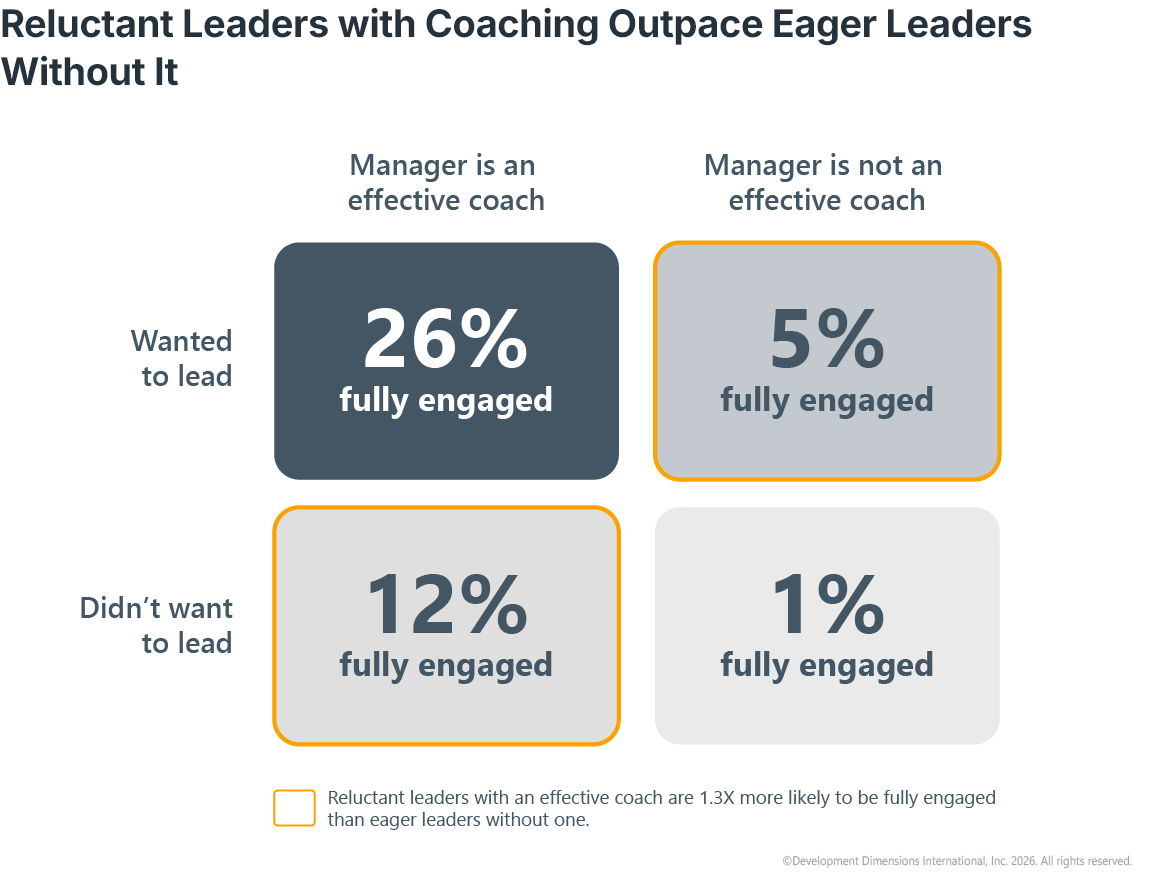
Leaders who wanted the role and have an effective manager coach are the most engaged group, at 26%. Leaders with neither are the least. The telling comparison sits between them. Leaders who never sought the role but have an effective manager coach are 1.3X more likely to be fully engaged than leaders who wanted it but lack that coaching.
The results are nearly identical when the question is whether a manager meaningfully supports a leader's development: 13% of reluctant leaders with that support are fully engaged, compared with 5% of eager leaders without it.
Without coaching, even the leaders who wanted the job rarely reach full engagement. Just 5% do. And most leaders are going without it: only 25% say their manager is an effective coach.
That matters because plenty of leaders didn't ask for the role. One in four leaders say they didn't want to be a leader before they were asked or had the opportunity. Frequent organizational restructuring moves people into jobs they didn't plan for, the scope of those jobs keeps shifting, and a steady stream of headlines asks whether anyone wants to lead at all. The result is many leaders doing a job they didn't seek, or one that looks very different from the job they took on. Organizations can't control who raises their hand, and many of their leaders never did. They can control the support those leaders get.
Engagement can be shaped after the promotion, by whether someone invests in a leader’s growth.
If engagement came down to who wanted the job, organizations would be stuck with the leaders they already have. However, the data shows that engagement can be shaped after the promotion by whether someone invests in a leader's growth.
Worauf man sich konzentrieren sollte
Move Leaders from “Somewhat” to Fully Engaged
Because so few leaders have checked out, the priority isn't rescuing the disengaged. It's moving somewhat engaged leaders toward full engagement.
It's tempting to solve that at the front door by choosing leaders who want the job. Understanding a candidate's motivation to lead is valuable, and it should be part of any promotion decision. But selecting leaders for motivation alone won't give you engagement. Organizations can't fill every leadership role with eager candidates, and even leaders who wanted the role often end up in a job that looks different from the one they signed up for. Motivation also isn't enough without support: among leaders who wanted the role but lack effective coaching, just 5% are fully engaged.
Leader engagement must be built into the role, not just at the point of selection. The factors most strongly tied to leader engagement point to three places HR and L&D can act:
1. Raise the bar on manager coaching.
Two of the factors most closely tied to leader engagement come straight from a leader's own manager: effective coaching and meaningful support for their development. Getting the feedback they need from their manager is close behind. Only a quarter of leaders say their manager is an effective coach, and 27% say their manager meaningfully supports their development.
That's a skill gap, not an effort gap. Coaching well, by asking the right questions, giving useful feedback, and helping a leader work through a real challenge, has to be learned, and too few managers have been developed to do it. In many organizations, leaders get good coaching only if they happen to report to someone who's good at it. Others piece together "good enough" guidance on their own, increasingly from AI tools. But good enough won't move a leader from somewhat to fully engaged. Treat coaching as a core skill for anyone who leads, develop it deliberately, and hold managers to a standard of quality, not just frequency.
Treat coaching as a core skill for anyone who leads, develop it deliberately, and hold managers to a standard of quality, not just frequency.
2. Show leaders where they're headed.
Beyond enjoying the role itself, the factor most closely tied to engagement is whether leaders understand their future career path in the organization. Feeling that they're advancing at an acceptable rate matters too. Twenty-five percent of leaders say they understand their future career path in their organization. Twenty percent strongly agree that they're advancing at an acceptable rate.
This is where HR has the most direct control. Career paths are often clearer to the people who design them than to the people on them. Make the path visible: which roles come next, what capabilities they require, and how today's development connects to getting there. And widen what counts as a path. A career lattice, with lateral moves across functions alongside promotions, opens more ways to grow. So do stretch assignments within a leader's current role. Both build capability and a sense of progress, even when the next rung up isn't available yet. For a somewhat engaged leader, a clear next step gives the current role meaning.
3. Support leaders through the job they didn’t sign up for.
Many leaders who didn't seek the role stepped up because their organization needed them, or because a manager saw potential they hadn't yet seen in themselves. That makes the support they get afterward all the more important. Too often, new leaders are left to sink or swim. But with a manager who coaches and supports them, leaders who didn't seek the role are more engaged than eager leaders who are left on their own.
The same holds for leaders whose role has grown or shifted since they took it on. Plan for both, especially after a restructure or a period of rapid growth. Pair new and unexpected leaders with managers equipped to coach them from the start, and treat a major change in scope like a new promotion: a moment to reset development, not a change leaders are expected to absorb on their own.
With a manager who coaches and supports them, leaders who didn't seek the role are more engaged than eager leaders who are left on their own.
Why Investing in Leader Engagement Pays Off
A fully engaged leader is far more likely to bring out the best in their teams, and leaders are more likely to be fully engaged when their own managers develop them. Taken together, that suggests engagement moves through an organization as leaders develop one another. Leaders who reinforce their own team members' development tend to be more engaged, too.
That development happens within a broader culture, and culture matters too. Organizations that support a positive employee experience and are dedicated to well-being also tend to have more engaged leaders. But much of the culture people experience day-to-day comes from the leaders in front of them. Develop those leaders, and you strengthen both.
Haben Sie eine Frage?
FAQs About Leader Engagement
-
What is leader engagement, and how does DDI measure it?

Leader engagement is the degree to which leaders are invested in their work: fully present in it and motivated by it, beyond simply being satisfied with their jobs. In the Global Leadership Forecast 2027, DDI measures leader engagement across three facets: how immersed leaders feel in their work, how energized it makes them, and how much meaning and purpose they find in it. A leader is considered fully engaged only when they strongly experience all three.
-
What percentage of leaders are fully engaged at work?
Only 9% of leaders are fully engaged, according to DDI's Global Leadership Forecast 2027. That ranges from 8% of frontline leaders to 15% of C-level leaders. But very few leaders have checked out completely: just 0.3% are fully disengaged. Instead, half of all leaders (50%) sit in a lukewarm middle, experiencing immersion, energy, and purpose only partially. The remaining 41% have a mixed experience that shifts from one facet of engagement to another.
-
How do fully engaged leaders differ from somewhat engaged leaders?
Fully engaged leaders report much stronger leadership outcomes. Compared with somewhat engaged leaders, they are 8.8X more likely to say they consistently bring out the best in their team members; 2.1X more likely to collaborate beyond their immediate team to get work done; and 2.9X more likely to rate themselves among the top 10% of leaders.
-
How are coaching and leader engagement connected?
Coaching from a leader's own manager is one of the factors most closely tied to leader engagement, more so than whether a leader wanted the role in the first place. In DDI's Global Leadership Forecast 2027, leaders who never sought the role but have an effective manager coach are 1.3X more likely to be fully engaged than leaders who wanted it but lack that coaching. Yet effective coaching is rare: only a quarter of leaders say their manager is an effective coach.
-
What can organizations do to strengthen leader and manager engagement?
Because almost no leaders are fully disengaged, the priority is moving somewhat engaged leaders toward full engagement. Selecting leaders for motivation helps, but it isn't enough: many leaders step into roles they didn't seek or that have changed since they took them on. DDI's research points to three places to act: raise the bar on manager coaching, help leaders understand their future career path in the organization, and support leaders through the job they didn't sign up for.